Armistice Day: The Weapons That Marked the End of the First World War
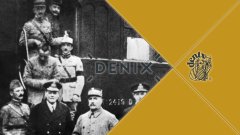
At around five in the morning on Monday 11 November 1918, in a railway carriage standing in a clearing in the Compiègne forest, Marshal Ferdinand Foch witnessed the signing of the armistice that ended more than four years of war. Yet the agreement did not bring the fighting to an immediate halt, as the ceasefire would not come into force until eleven o'clock that morning. During those six hours, while Europe waited for the conflict to end, rifles, machine guns and artillery continued to claim lives.
But to understand how things had come to that railway carriage, and what part weapons played in the conflict, we must go back to its first months.
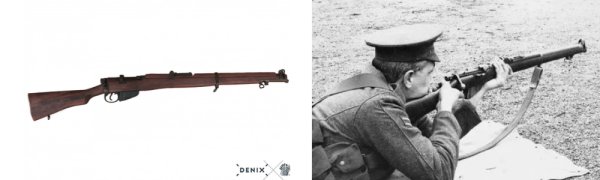
In August 1914, when the British Expeditionary Force landed in France, its soldiers were equipped with the Short Magazine Lee-Enfield Mk III, a rifle that had been in service since January 1907. It was so effective that British riflemen were required to achieve a rate of roughly fifteen aimed shots a minute. Indeed, a widespread legend holds that, at the Battle of Mons, German troops mistook the speed of their fire for machine guns.
Anecdote aside, the Lee-Enfield certainly became one of the most representative weapons of the British Army. Proof of this is that, by the end of the war, close to four million examples of the Mk II and Mk III versions had been issued.
Curiously, the town of Mons also holds one of the most poignant coincidences of the First World War: in St Symphorien Military Cemetery, just a few metres apart, lie the first and the last Commonwealth soldiers killed in action during the conflict. It is a place that, in a way, symbolises the beginning and the end of those four years of tragedy.
Today, our SMLE Mk III rifle replica lets us get closer to the history of one of the weapons that accompanied the British infantry from the first clashes of 1914 to the final shots of November 1918.
If you would like to learn more fascinating facts about this weapon, be sure to read 'Guns and their history: the SMLE Mk III rifle'.
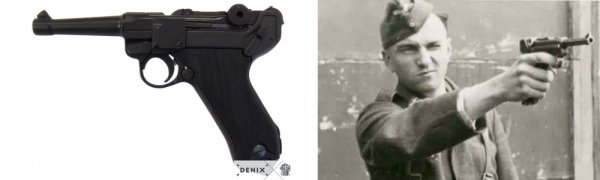
As the war went on, close-quarters fighting became ever more frequent, especially in the trenches, where the cramped space made rifles difficult to use. In this setting, pistols took on an unexpected importance. One of the most iconic was the Pistole 08, adopted by the German Army in 1908 and known as the Luger Parabellum. Its versatility gave rise to several versions, among them the Luger P08 artillery model, fitted with a 200-millimetre barrel and able to use, from 1916, a 32-round drum magazine. Thanks to these features and its detachable stock, it offered performance close to that of a compact carbine.
However, the Luger was not the only German pistol to leave its mark on the conflict. Alongside it stood the Mauser C96, easily recognised by its long barrel and distinctive ‘broomhandle’ grip. Although it pre-dated the war, it took on particular importance in 1916, when the Imperial Army ordered a version adapted to the 9 mm Parabellum calibre. These pistols, known as the ‘Red 9’ after the number nine painted in red on their grips, reached a production of approximately 100,000 units and became another example of how weaponry had to adapt to the demands of the front.
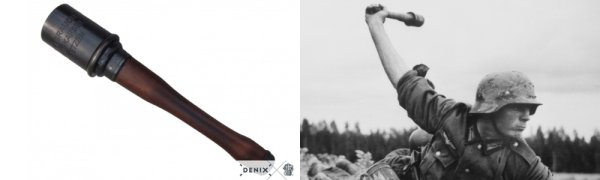
Hand grenades also underwent significant development during the First World War, particularly once trench warfare showed the need for effective weapons at close range. At the start of the conflict, Germany had a spherical model weighing around 750 grams, used mainly by sappers. In 1915, however, the Stielhandgranate appeared, known as the ‘stick grenade’ and nicknamed the ‘potato masher’ by the Allies because of its peculiar shape. Its wooden handle made it easier to throw over a greater distance, making it one of the most characteristic weapons of the German Army, whose design can be explored today through the DENIX replica. Meanwhile, on the other side of the front, the United States developed the Mk 2 ‘pineapple’, heir to earlier designs such as the French F1. Although its origins date back to the last months of the war, in 1918, it was during the Second World War that it would achieve its greatest renown.
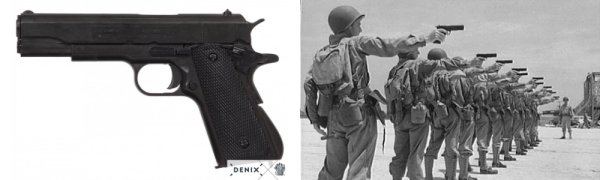
On 8 October 1918, as the First World War drew to a close, the American corporal Alvin York took part in one of the most famous episodes of the Meuse-Argonne Offensive. During an operation with his patrol, he managed to capture a German command post, but enemy machine-gun fire killed six of his comrades. In the midst of the fighting, six German soldiers charged at him with fixed bayonets and York, armed with his pistol, managed to bring them down before they reached him. Despite the situation, he made it back to the American lines with 132 prisoners, a feat for which he would later receive the Medal of Honor. The weapon he used was a .45-calibre Colt M1911, adopted by the US Army in 1911 and one of the most iconic designs in military history. Today, the DENIX M1911A1 reproduces a later evolution of the pistol that accompanied York in one of the most remembered moments of the conflict.
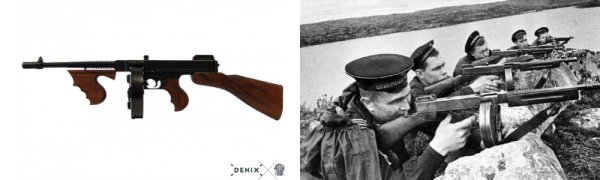
Trench warfare also spurred the development of new automatic weapons, designed to meet the demands of close-quarters combat. Among those seeking a solution was the American general John T. Thompson, who envisaged a veritable ‘trench broom’: a portable .45-calibre weapon capable of sweeping enemy positions quickly. His project, christened the ‘Annihilator’, was practically complete by 1918, but the armistice arrived before its prototypes could see combat. In fact, a well-known story claims that the first units were awaiting shipment to Europe on that very 11 November, although the truth of this episode is still debated. Meanwhile, Germany had already introduced the Bergmann MP 18 among its assault troops, regarded as one of the first submachine guns in history. Although Thompson's project did not take part in the First World War, its development continued in the years that followed and gave rise to such iconic models as the Thompson M1928, a replica of which is part of our catalogue.
The terms of the armistice reflected the scale of a war marked by the industrialisation of combat. Among its clauses, Germany was to hand over 5,000 guns, 25,000 machine guns and 3,000 trench mortars, along with thousands of locomotives, wagons and lorries. Yet while the final preparations for the ceasefire were being made, weapons continued to claim lives. According to the historian Joseph Persico's estimates, around 10,900 casualties, killed, wounded and missing, were recorded on that final 11 November, of which approximately 2,738 were fatal. Among them was the American soldier Henry Gunther, who died at 10:59 in the morning, barely a minute before the armistice came into force, as he advanced on a German position. His death, regarded as the last of an American serviceman in combat during the First World War, symbolises the tragedy of those final hours. At eleven o'clock sharp, after more than four years of fighting and around nine million military deaths, the guns finally fell silent. So ended one of the most devastating wars in history, although its consequences would shape the fate of Europe for decades.
At DENIX we preserve that memory with decorative replicas that bring us, with respect, closer to the objects that shaped history, without ever forgetting the lives behind each one of them. We invite you to explore our catalogue, where in the World Wars section you will find the pieces featured in this text, and to keep reading the DENIX blog, where we look back at other stories well worth remembering.



 DENIX
c/ Bijuters, 6, Polígono Industrial 07760 Ciutadella de Menorca Balearic Islands - Spain Telephone: (+34) 971 38 15 61 - 629 872 838
www.denix.es
支持之下